
Gallery wall sizes: which frames to use and how many
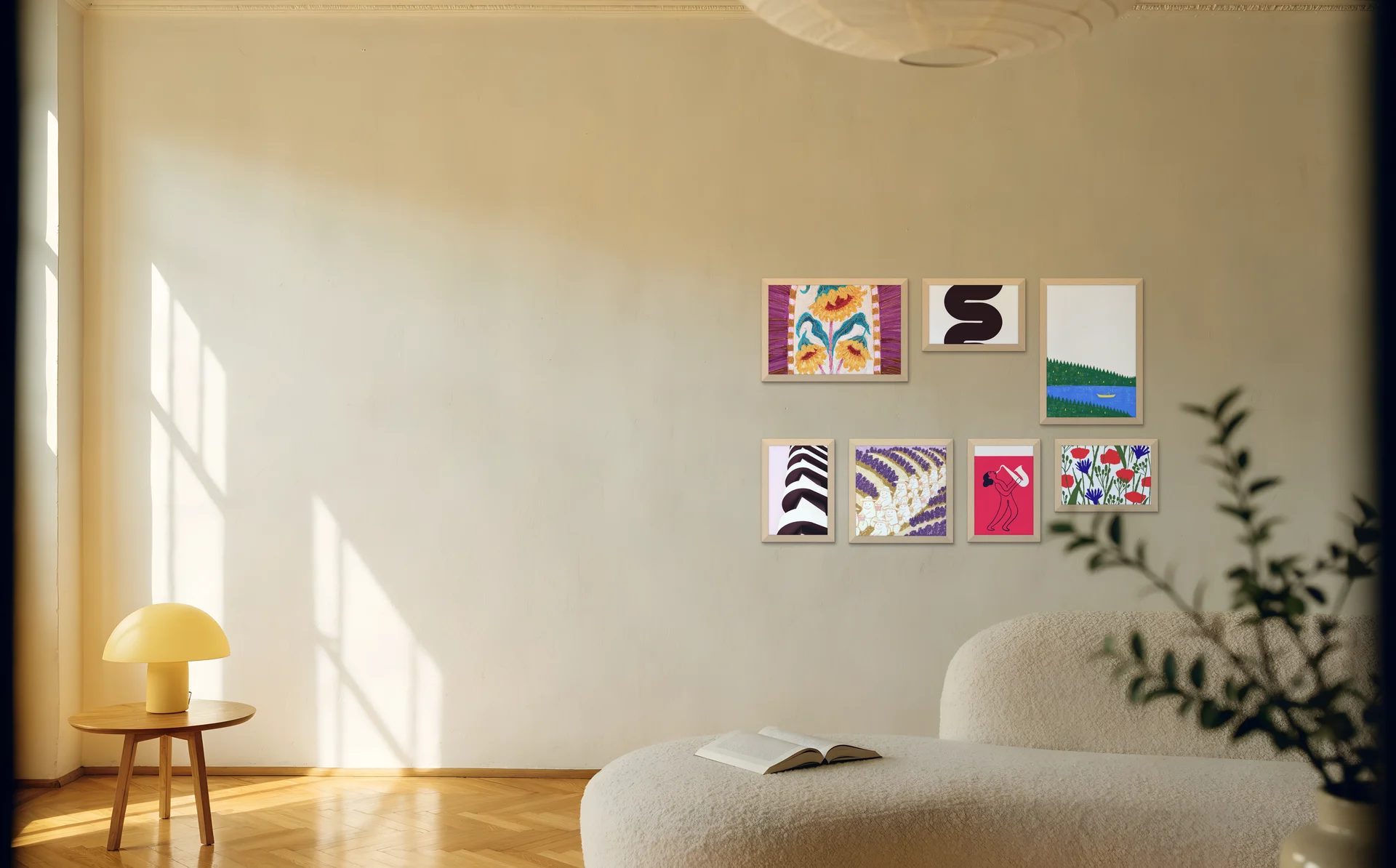
For a gallery wall, mix 2 to 3 standard frame sizes (such as 8x10, 11x14 and 16x20) around one larger anchor like a 24x36 (61x91 cm), then size the whole arrangement to span 66% to 75% of the furniture beneath it. A starter wall uses 3 to 5 pieces; a full statement wall uses 8 to 15. The rest of this guide turns those gallery wall sizes into a plan for your own wall.
How many frames do you need for a gallery wall?
A starter gallery wall is 3 to 5 pieces and a full statement wall is 8 to 15. To pin down the exact number, budget about 1 frame for every 1.5 to 2 square feet (0.14 to 0.19 square metres) of the area you want to cover, then round to whatever count balances best around your anchor.
People imagine the wall as one big shape and underestimate how many frames fill it. Measure the area you actually want art to occupy, not the whole wall. Divide that area by 1.5 to 2 square feet per frame and you land in the right range without guessing. A 1.5 square foot (0.14 square metre) divisor gives you a denser, more packed wall; a 2 square foot (0.19 square metre) divisor gives you more breathing room between frames.
Start from one anchor frame and work outward. Pick your largest piece first, then add satellites in pairs around it until you reach your target count and span. An odd total often settles more easily than an even one, because a single anchor with balanced sides reads as composed rather than split down the middle.
The shape you arrange those frames into, whether a grid, a salon hang or a symmetrical block, is a separate decision. Our guide to how to choose a gallery wall layout covers that part.
Gallery wall sizes: what size frames should you use?
Use 2 to 3 standard sizes with one larger anchor. A blend of 8x10, 11x14 and 16x20 around a single 24x36 (61x91 cm) anchor reads as more collected and deliberate than a row of identical small frames. The one exception is a uniform grid, where every frame is the same size on purpose.
Choose your one largest frame as the visual anchor and place it first. Size the satellites around it so the arrangement has a clear centre of weight. A wall of similar-sized frames with no anchor gives the eye nowhere to settle, which is why mixed sizes usually look more intentional.
Standard gallery wall frame sizes (with metric equivalents)
These are standard reference sizes, not rules you must follow. Imperial sizes are common outside the UK and across most off-the-shelf frame ranges; A-series sizes are standard across the UK and Europe.
| Frame size | Metric | Typical role on the wall |
|---|---|---|
| 8x10 in | 20x25 cm | small satellite |
| 11x14 in | 28x36 cm | mid satellite |
| 16x20 in | 41x51 cm | large satellite |
| 18x24 in | 46x61 cm | secondary anchor |
| 24x36 in | 61x91 cm | main anchor |
| A4 | 21x30 cm | small satellite |
| A3 | 30x42 cm | mid satellite |
| A2 | 42x59 cm | large satellite or anchor |
For the print resolution each size needs so it stays sharp, see what size to print photos for your wall. That post is the canonical guide for print size and resolution; this one stays on frame dimensions and counts.
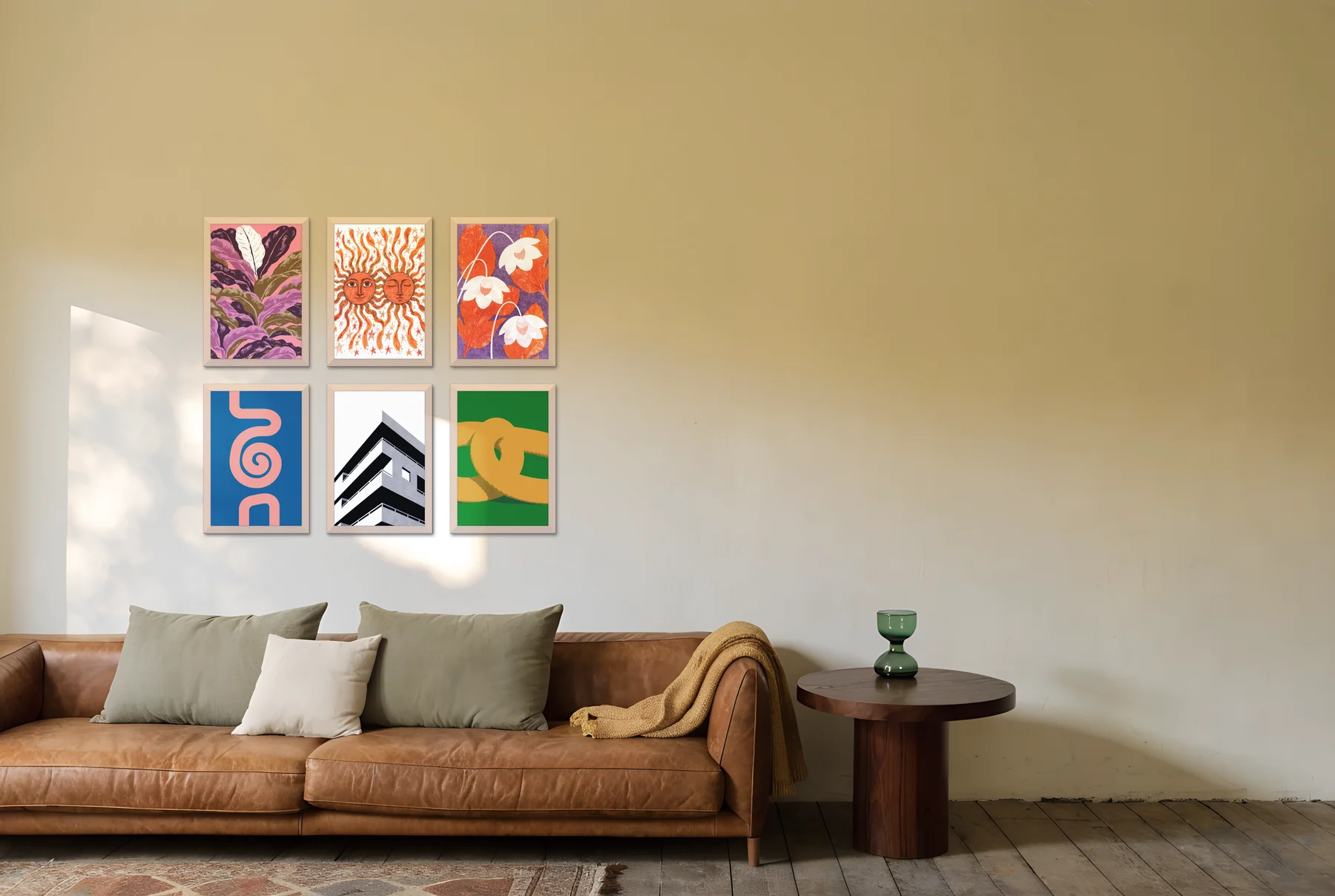
How wide should a gallery wall be? The 66 to 75% scale rule
Size the whole arrangement to span 66% to 75% of the width of the furniture beneath it. MontCarta states it directly: "Wall art should occupy 66% to 75% of the furniture's width." Measure your furniture, multiply the width by 0.66 and by 0.75, and aim for a combined art span (frames plus gaps) inside that band.
MontCarta gives a worked example: "three 18-inch frames with 2-inch gaps... total width is 58 inches... a near-perfect fit for a 90-inch sofa." Three 18-inch (46 cm) frames give 54 inches (137 cm) of art, plus two 2-inch (5 cm) gaps add 4 inches (10 cm), for 58 inches (147 cm) total. That works out at 64% of a 90-inch (229 cm) sofa, which sits just under the 66% floor, so treat the band as a target with a little give at the bottom rather than a hard cut-off. If you want to land squarely inside it, widen a gap or size one frame up. The gallery wall calculator does this sum for you: enter your frame size, gap, rows and columns and it returns the total span and tells you where it falls against the furniture width.
The exact gap between frames is its own decision, and our gallery wall spacing guide is the canonical reference for it. A consistent 2 inch (5 cm) gap is a safe default while you settle on sizes.
Worked example: a gallery wall above a 2 metre sofa
For a 2 metre (about 79 inch) sofa, target an art span of about 1.3 to 1.5 metres (52 to 59 inches). One mix that hits it: a single 24x36 (61x91 cm) anchor plus four 11x14 (28x36 cm) satellites, with a consistent 50 mm (2 inch) gap between every frame. Hang the anchor upright with two landscape satellites stacked either side of it, and the group spans 56 inches (142 cm), inside your target band.
| Sofa width | Target span at 66% to 75% | Suggested frame mix |
|---|---|---|
| 79 in (200 cm) | 52 to 59 in (132 to 150 cm) | one 24x36 anchor plus four 11x14 satellites |
| 90 in (229 cm) | 59 to 68 in (150 to 173 cm) | MontCarta's three 18-inch frames at 58 in sits just below this band |
Centre the arrangement on the sofa, not on the wall, so the art reads as belonging to the seating below it.
The most common gallery wall sizing mistake
The most common sizing mistake is going too small. Bluethumb's art advisory team puts it plainly: "the most common mistake with size is going too small for the space." When you are unsure between two sizes, size up.
Small art on a large wall leaves the furniture below it looking unanchored. The 66 to 75% rule is your guard against that. If your planned arrangement falls below 66% of the furniture width, add a frame, swap a satellite for a larger size, or promote your anchor to the next size up.
Test your frame sizes before you buy
Cut a paper or cardboard template the exact size of each frame and hold it to the wall before you order anything. Bluethumb's advice is to "cut out a sheet of paper or cardboard the exact size of the mounted artwork and hold it to the wall." Tape the templates up in your planned arrangement, step back to where you normally sit, and check the span against the furniture. Mark each frame's hook position on its template, measuring down from the top of the frame to the taut wire or D-ring, so you can transfer the layout straight to the wall later. Before you drill or nail, check those marks with a cable and pipe detector.
If cutting paper for 8 frames sounds like a chore, a planner lets you try the same arrangement on screen. A tool like Curate shows each frame on a photo of your own wall, so you can compare a 16x20 against a 24x36 anchor and check the 66 to 75% span before you spend anything. You move frames around, swap sizes, and read the proportion against your own sofa instead of estimating it.
Once your sizes and count are settled, the full sequence from measuring to hanging is laid out in how to plan a gallery wall, and the height to hang it at is covered in how high to hang a gallery wall. For room-by-room ideas on what to put in the frames, see our gallery wall ideas.
Frequently asked questions
How many frames make a gallery wall?
A starter gallery wall is 3 to 5 frames and a full statement wall is 8 to 15. As a planning rule, budget about 1 frame for every 1.5 to 2 square feet (0.14 to 0.19 square metres) of the area you want to cover.
What is the most common gallery wall sizing mistake?
Going too small. Bluethumb's art advisory team says "the most common mistake with size is going too small for the space," so when you are unsure between two sizes, size up.
How wide should a gallery wall be above a sofa?
Span 66% to 75% of the sofa width. For a 2 metre (about 79 inch) sofa, that means an art span of roughly 1.3 to 1.5 metres (52 to 59 inches), such as one 24x36 (61x91 cm) anchor plus four 11x14 (28x36 cm) satellites.
Should all gallery wall frames be the same size?
No, unless you are building a deliberate uniform grid. Mixing 2 to 3 standard sizes (for example 8x10, 11x14 and 16x20) with one larger anchor like a 24x36 (61x91 cm) reads as more collected and intentional.
What is the best anchor frame size for a gallery wall?
Pick one largest frame as the anchor and size everything around it. A 24x36 (61x91 cm) works well above a standard sofa; for a console or a smaller wall, an 18x24 (46x61 cm) or 16x20 (41x51 cm) anchor suits the space better. Hang a glazed 24x36 anchor on two hooks or D-rings rather than one nail: it is heavy, and above a sofa it sits over people's heads.
Settle the count and the span first, then choose the frames that hit them. When you want to see your mix on your own wall, open the Curate planner and drop your sizes onto a photo of the space before you buy a single frame.