
How high to hang a gallery wall: the 57-inch rule explained

Hang a gallery wall so the centre of the whole grouping sits 57 inches (145 cm) above the floor. Treat the cluster as one rectangle, find its centre, and place that centre at 57 inches. This is the widely used gallery convention for how high to hang a gallery wall, and it works in almost every room because it lands the art at average human eye level. The most common height mistake is hanging too high, so if you are unsure, you are aiming above the mark, not below it.
That one number does most of the work; the rest of this guide covers the handful of rooms where you override it, the scale rule that sets how wide your arrangement should be, and the measuring formula that lands the hook in the right spot on the first try.
What is the 57-inch rule for hanging art?
The 57-inch rule means you hang artwork so its centre point sits 57 inches (145 cm) above the floor, not the top edge and not where it feels right by eye. You measure to the middle of the piece, then work backwards to find the hook. It is a widely used gallery convention rather than a fixed rule.
Apartment Therapy founder Maxwell Ryan popularised the phrase "57 inches on centre", and notes it "is regularly used as a standard in many galleries and museums". The number is not arbitrary. Art Academi describes 57 inches, or about 145 cm, as "a practical average human eye level". Galleries hang to a shared centre line so a room full of differently sized works reads as one calm, level band rather than a staircase of mismatched tops. You get the same effect at home.
Ryan is blunt about why people get it wrong: "57 inches on center tends to be a lot lower than most people naturally hang their artwork. People hang things too high (I don't know why they do this)." Keep that line in mind when your instinct says to nudge the whole thing up, because that instinct is the problem the rule was written to fix.
How high should a gallery wall be above a sofa?
Above a sofa, ignore the 57-inch rule and measure from the furniture instead. Keep the bottom of the lowest frame 6 to 8 inches (15 to 20 cm) above the top of the sofa back. If cushions sit higher than the sofa back, measure from the top of the cushions instead. This ties the art visually to the seating so the two read as one composition. The same gap applies above a console. Above a bed or a dining-room sideboard, leave a little more: 8 to 12 inches (20 to 30 cm), measured on a bed from the headboard or the pillows, whichever is higher.
The 57-inch standard assumes an empty wall. The moment furniture sits below the art, the furniture becomes the anchor and the floor stops mattering. Art Academi sets the ceiling on that gap: "if the gap is larger than 10 inches, the art starts floating away toward the ceiling." So 6 to 8 inches (15 to 20 cm) is the target above a sofa, and 10 inches (25 cm) is the hard limit before the arrangement looks unmoored from the couch. Beds and dining-room sideboards are the exceptions, at 8 to 12 inches (20 to 30 cm).
In practice, the centre of a group above a sofa can land well above or below 57 inches, depending on how tall the group is. When the two rules conflict, the furniture gap wins. A worked example: if your sofa back sits 33 inches (84 cm) off the floor, the bottom frame goes at roughly 39 to 41 inches (99 to 104 cm), and you build the cluster upwards from there.
How wide should a gallery wall be over furniture?
Your arrangement should span about 66% to 75% of the width of the furniture beneath it. Too narrow and the art looks marooned in the centre of the wall; too wide and it overwhelms the piece below. This single ratio fixes more "something looks off" problems than any height tweak.
MontCarta states the rule: "Wall art should occupy 66% to 75% of the furniture's width." They give a clean worked example: "three 18-inch frames with 2-inch gaps... total width is 58 inches... a near-perfect fit for a 90-inch sofa." Run the maths yourself before you hang. A 58-inch (147 cm) spread over a 90-inch (229 cm) sofa is 64%, just under the band and still a comfortable, grounded look.
To apply it to your own wall, measure the furniture width, multiply by 0.66 and by 0.75, and keep your total arrangement width (frames plus the gaps between them) inside that range. Gaps of 2 to 3 inches (5 to 7.5 cm) between frames keep a gallery group reading as one unit rather than scattered pieces.
| Furniture width | Target art span (66% to 75%) | Example arrangement |
|---|---|---|
| 60 in (152 cm) sideboard | 40 to 45 in (102 to 114 cm) | Two to three medium frames |
| 84 in (213 cm) sofa | 55 to 63 in (140 to 160 cm) | Three to five frames |
| 90 in (229 cm) sofa | 59 to 68 in (150 to 173 cm) | Three 18 in frames, 2 in gaps (per MontCarta) |
| 72 in (183 cm) bed (super king) | 48 to 54 in (122 to 137 cm) | Two large or four small frames |
When should you break the 57-inch rule?
Break the 57-inch rule in four situations. Above furniture, measure from the furniture instead of the floor. In dining rooms and bedrooms, raise the centre to about 59 inches (150 cm): a dining wall is seen from across the room, and a bedroom wall mostly while you are standing. Under tall ceilings of about 9 feet (2.7 m) or more, go up to 59 or 60 inches (150 to 152 cm). The one case for going lower is a wall you mostly see from a chair, such as a reading corner: drop the centre 2 to 6 inches (5 to 15 cm).
The logic is consistent every time you adjust: hang to the eye level of how the room is used. A hallway is a standing, walking space, so 57 inches (145 cm), or even a touch higher, suits it. A dining wall is mostly seen from across the room, which is why it sits a little higher rather than lower. The ceiling does not move eye level. An 8-foot (244 cm) ceiling, the usual height in UK homes, keeps the centre at 57 inches; raise it only under a ceiling of about 9 feet (2.7 m) or more, and stop at about 62 inches (157 cm).
| Room or situation | What you measure to | Target |
|---|---|---|
| Hallway or entryway (you only stand) | Centre of the grouping, from the floor | 57 to 61 in (145 to 155 cm) |
| Living room | Centre of the grouping, from the floor | 57 to 59 in (145 to 150 cm) |
| Dining room or bedroom | Centre of the grouping, from the floor | About 59 in (150 cm) |
| Reading corner (seen from a chair) | Centre of the grouping, from the floor | 51 to 55 in (130 to 140 cm) |
| Empty wall, standard 8 ft (2.4 m) ceiling | Centre of the grouping, from the floor | 57 in (145 cm) |
| Above a sofa or console | Bottom frame, from the furniture top | 6 to 8 in (15 to 20 cm), 10 in (25 cm) max |
| Above a bed or dining-room sideboard | Bottom frame, from the headboard or pillows (whichever is higher) or the sideboard top | 8 to 12 in (20 to 30 cm) |
| Tall ceiling, about 9 ft (2.7 m) or more | Centre of the grouping, from the floor | 59 to 60 in (150 to 152 cm), 62 in (157 cm) max |
This is also where the often-quoted "60 inches" comes from, and the two numbers are easy to reconcile.
Is it 57 inches or 60 inches on centre?
Lead with 57 inches (145 cm), and go up to about 59 to 60 inches (150 to 152 cm) in hallways, entryways, dining rooms and bedrooms, or in rooms with tall ceilings where a higher line balances the volume. The 57-inch figure is a gallery convention built on average eye level, and it works whether you sit or stand.
Both numbers are defensible; they answer different rooms. If you default to 57 inches and only adjust upwards for dining rooms, bedrooms, hallways and tall ceilings, you will never be far off. Default to 60 inches instead, and you tend to reinforce the common habit of hanging too high.
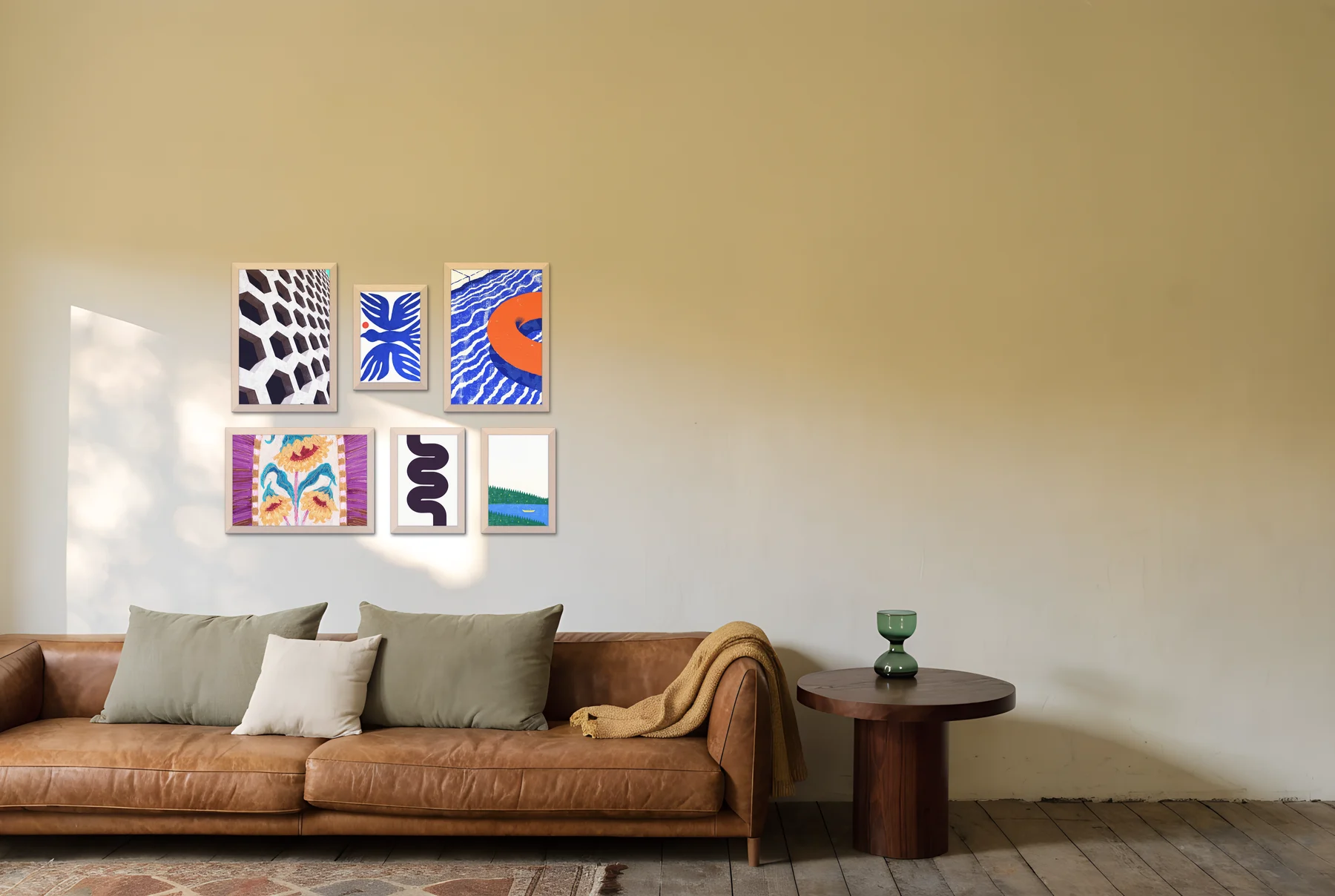
How do you hang a gallery wall (not a single frame) at the right height?
Treat the entire gallery as one large rectangle. Find the outer edges of the whole arrangement, locate the centre of that rectangle, and put that centre at 57 inches (145 cm). You hang to the maths of the group, never to the eye level of any individual frame.
This is the step most people skip, and it is why gallery walls drift upwards. If you hang the first frame at your standing eye level and build outwards, the centre of the finished cluster ends up far above 57 inches (145 cm). Instead, plan the full shape first. Lay every frame out on the floor, or cut paper templates and tape them to the wall, and shuffle until the composition works. Keep the gaps even at 2 to 3 inches (5 to 7.5 cm), which suits most walls, then measure the overall block.
Once the layout is fixed, the centre of the block is your 57-inch target, and you reverse-engineer each individual hook from there. A gallery-wall planner does this rectangle-and-centre maths for you: you set the heights and see how the whole arrangement fits on a photo of your own wall before you commit to a single hole. That is the part worth getting right before the hammer comes out, because the cost of guessing is real. In a 2024 Clever Real Estate survey of 1,000 US homeowners, 35% said they had had to completely redo a home renovation project.
What is the formula for where to put the nail?
Set each hook at this height: 57 + (half the frame height) minus (the drop from the frame's top edge to the taut hanging wire). For a 24-inch (61 cm) frame whose wire pulls 3 inches (8 cm) below the top edge, that is 57 + 12 minus 3 = 66 inches (168 cm). Mark the wall at 66 inches, set your hook, and the centre of that frame lands at 57 inches (145 cm). Before you nail or drill, check the spot with a cable and pipe detector, especially in line with sockets and switches.
Each term does one job. The 57 places the centre. Adding half the frame height moves you up to the top edge. Subtracting the wire drop accounts for how far the frame hangs below the nail. Measure that wire drop with the wire pulled tight towards the top, the way it will sit under the frame's weight, because a slack wire hangs lower than a taut one. For frames wider than about 24 inches (60 cm), use two hooks at the same height and measure the drop to the D-rings instead.
For a gallery wall, you run this calculation per frame against the group's planned positions, not against a single 57-inch line for every piece. The shared reference is the centre of the whole rectangle. The gallery wall calculator runs that sum for you: enter your frame size, gap, rows and columns and it returns the hook height to mark and how far out from the centre line each hook sits.
How do you hang a gallery wall up a staircase?
On a staircase, follow the slope of the stairs rather than a single horizontal line. Keep the centre of each frame at the same height above the tread directly below it, 57 to 61 inches (145 to 155 cm), so the arrangement climbs at the same angle as the steps. The eye-level rule still applies on stairs, measured from the tread under each frame, because there is no single floor level.
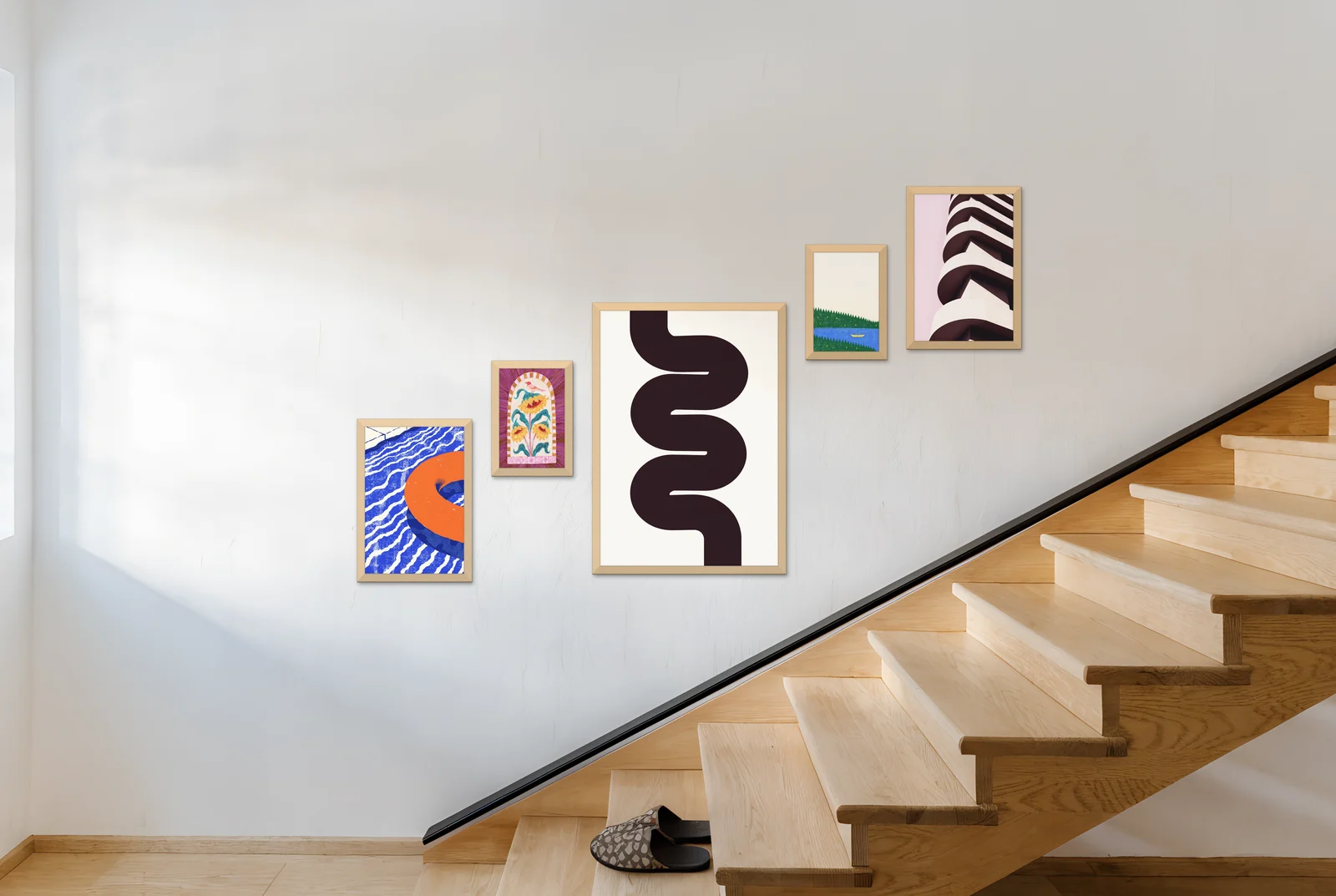
Stair galleries intimidate people; the question a Houzz poster asked, "How high up from the landing?", is the one everyone has. The answer is to measure from the stair nosing straight up to the centre of each frame, hold that height at 57 to 61 inches (145 to 155 cm), and repeat it as you ascend. Keeping that height the same, on a centre line parallel to the stairs, is what makes a stair gallery look deliberate. Cut paper templates and tape them in place first; on stairs, plan the climb rather than trusting your eye mid-staircase.
Frequently asked questions
How high should you hang a gallery wall?
Centre the whole grouping at 57 inches (145 cm) above the floor, a widely used convention for average eye level. Treat the arrangement as one rectangle and place its centre point at that height. Above furniture, switch to measuring from the furniture instead.
How high should art hang above a couch?
Keep the bottom of the lowest frame 6 to 8 inches (15 to 20 cm) above the top of the sofa back, or the cushions if they sit higher. Do not exceed 10 inches (25 cm), or the art starts to look like it is floating away from the couch, as Art Academi puts it.
Is the 57-inch rule measured to the centre or the top of the art?
To the centre. You position the midpoint of the piece, or the midpoint of a whole gallery group, at 57 inches (145 cm), then calculate the hook height from there using half the frame height minus the wire drop.
Why do gallery walls so often end up too high?
Because people hang to their standing eye level instead of to the centre of the arrangement. Maxwell Ryan puts it bluntly: "57 inches on center tends to be a lot lower than most people naturally hang their artwork." Planning the full rectangle and measuring to its centre corrects the drift.
Should a gallery wall be wider or narrower than the sofa?
Narrower. Aim for the arrangement to span 66% to 75% of the furniture's width, per MontCarta. Over a 90-inch (229 cm) sofa, that is roughly 59 to 68 inches (150 to 173 cm) of art including the gaps between frames.
Get the height and the layout settled before you pick up a hammer. You can lay out your frames on a photo of your own wall, set the heights, and check how the whole arrangement fits in the Curate planner first, then mark your hooks once and hang with confidence. For more, see our guides on how to plan a gallery wall from scratch and what size to print your photos for the wall.