
Gallery wall spacing: the exact gap between frames

For gallery wall spacing, leave a consistent 2 to 3 inches (5 to 7.5 cm) between frames. That gap suits most mixed walls. The number matters less than the consistency: pick one gap, hold it identical between every frame, and the whole arrangement reads as deliberate rather than scattered.
That single rule does most of the work. The rest of this guide covers when to tighten the gap for a strict grid, when to widen it for big frames, how to keep it even by hand, and how to handle the harder cases: mixed frame sizes, the space around the edges, and grid walls versus salon walls. Every measurement is given in both inches and centimetres so you can work straight from a tape measure.
How far apart should pictures be on a gallery wall?
Hang gallery wall frames 2 to 3 inches (5 to 7.5 cm) apart, measured from the edge of one frame to the edge of the next, and keep that gap the same across the whole wall. A 50 mm (2 inch) gap sits at the tighter end of that band and works for almost any mix of frames.
Two inches is easy to remember and easy to repeat. It is small enough that the frames feel like one group, and large enough that each piece still has room to breathe. If you want a more relaxed wall, move to 3 inches (7.5 cm). Either is correct. What you should not do is let the gap wander between the two as you go along.
Measure edge to edge, not centre to centre. The visible white space between two frames is what your eye judges, so that is the distance you control. Centre-to-centre measurements drift the moment your frames are different sizes, which on most gallery walls they are.
If you are still deciding how many frames to hang and what sizes to buy before you get to spacing, start with our guide to gallery wall sizes and frame counts, then come back here for the gaps.
Why consistent gallery wall spacing matters more than the exact number
The eye reads even small inconsistencies as a mistake. A gap that drifts by half an inch (just over 1 cm) across a wall makes the whole arrangement look slightly off, even when nobody can point to why. The fix is to repeat the same gap everywhere, not to find a better number.
This is the part most spacing advice buries. Any sensible gap will give you a good wall as long as you apply it consistently, and even a well-chosen gap looks wrong when it drifts, so consistency is the part that does the real work.
So decide your gap once, write it down, and treat it as fixed for the rest of the layout. If you are mixing frame sizes, the gap stays the same between every neighbouring pair, regardless of how big or small those two frames are.
What gap should you use for your look?
Match the gap to the effect you want. Use 2 to 3 inches (5 to 7.5 cm) for a standard mixed wall, tighten to about 1.5 to 2.5 inches (4 to 6 cm) for a tight grid of matching frames, and widen towards 4 to 5 inches (10 to 13 cm) only for large or thick frames, roughly 28 inches (70 cm) and up. Then hold that gap everywhere.
| Look or feel | Gap between frames | Best for |
|---|---|---|
| Tight grid (matching frames) | 1.5 to 2.5 in (about 4 to 6 cm) | Identical frames in strict rows and columns, with every gap exactly equal |
| Standard (most walls) | 2 to 3 in (5 to 7.5 cm) | Mixed frame sizes, the default for living rooms, hallways and stairs |
| Large or thick frames | up to about 5 in (13 cm) | Oversized art, deep or heavy mouldings, fewer big statement pieces |
Framing experts at Tribeca Printworks recommend 1.5 to 2.5 inches (about 4 to 6 cm) between frames for a "museum-like effect", the range to use for a tight grid of matching frames. For the opposite case, Coohom recommends widening the gap up to about 5 inches (13 cm) for large or thick frames, so big pieces do not look cramped against each other. Scale the gap to the frames: small frames can sit close, large frames need more air.
Reconciling the conflicting advice (1.5 in vs 3 in vs 5 in)
You will find three different "right" answers online, and they only conflict because they describe different walls. Tribeca Printworks says 1.5 to 2.5 inches (4 to 6 cm) for a tight, museum look. The usual default for home walls is 2 to 3 inches (5 to 7.5 cm). Coohom says up to about 5 inches (13 cm) for large frames. None is wrong; each solves a different problem.
Here is how to resolve it in one move. Use 2 to 3 inches (5 to 7.5 cm) for a typical mixed wall. Tighten to about 1.5 to 2.5 inches (4 to 6 cm) for a tight grid of matching frames. Widen towards 4 to 5 inches (10 to 13 cm) only when your frames are oversized or thick. Then, whichever you pick, keep it consistent. The choice sets the character of the wall; the consistency makes it look finished.
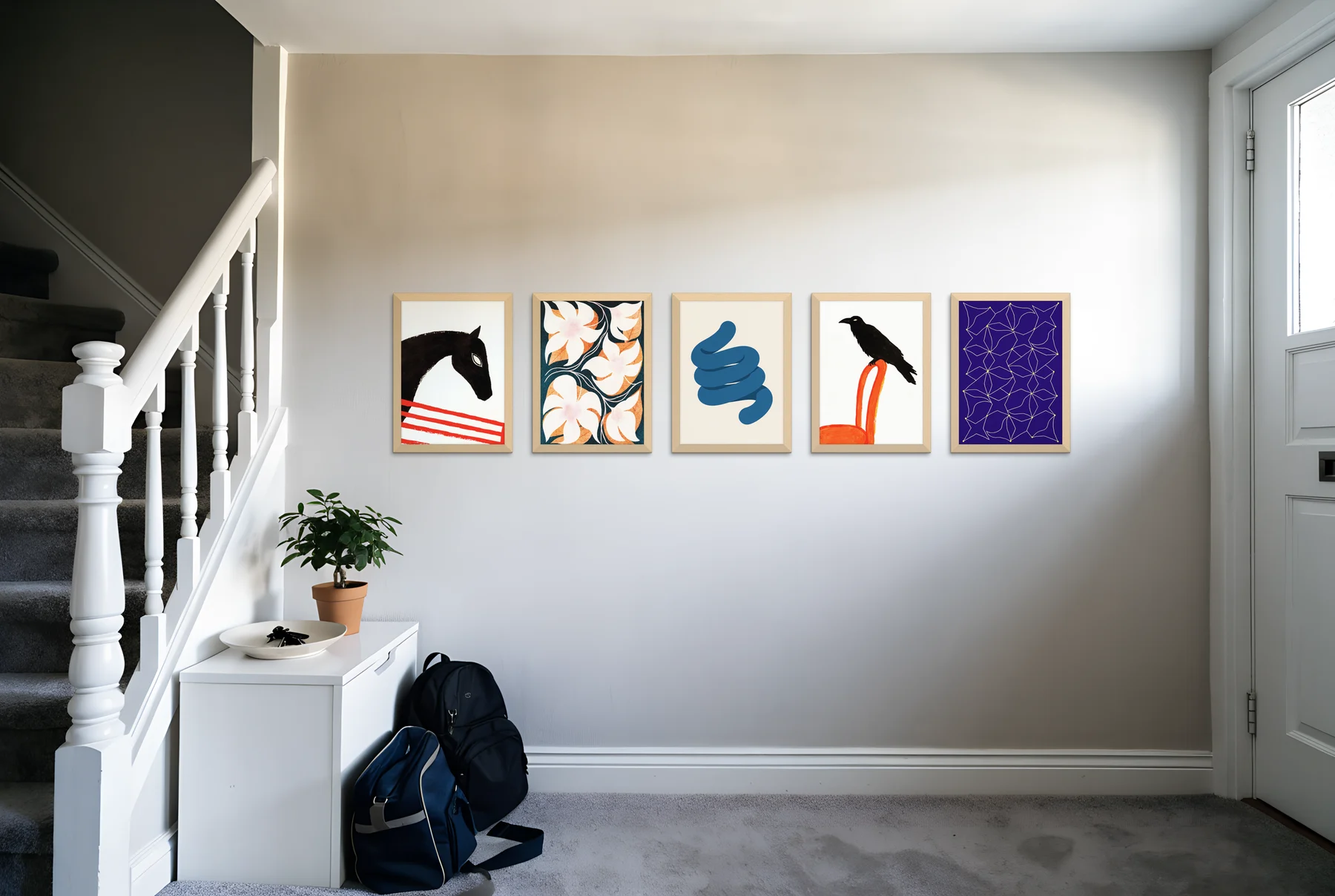
How to keep the gap identical between every frame
Use a physical spacer. Cut a piece of stiff card or a small block to your chosen gap, for example 50 mm (2 inches), and use that same spacer between every pair of frames as you lay them out. You stop measuring at each joint and start repeating one fixed object, which removes the drift that wrecks otherwise good walls.
A spacer beats a tape measure here because it is faster and far more consistent. Re-measuring 2 inches a dozen times invites a dozen small errors. Holding the same 50 mm block against each frame edge gives you the same gap every time, by definition. Lay the whole arrangement out on the floor first, set every gap with the spacer, then transfer it to the wall.
If you would rather not cut card and shuffle frames on the floor, a planner can hold the gaps even for you on screen as you move frames around, and it lets you compare a 2 inch and a 3 inch gap on a photo of your actual wall before you mark or drill anything. Seeing both gaps on your own wall usually settles the decision. You can try this in the Curate planner with a single photo. If you want the numbers before you open anything, the gallery wall calculator turns your frame size, gap and frame count into a total width and height.
For the full sequence from photo to finished wall, including measuring your space and laying out frames before you commit, see how to plan a gallery wall.
Edge spacing: the gap around the group
Leave more space between the gallery and the surrounding edges than you leave between the frames. The air around a sofa, a doorway, a ceiling line or the edge of the wall should be visibly larger than the 2 to 3 inch (5 to 7.5 cm) internal gap. That margin makes the cluster read as one block instead of a set of pictures crowding the furniture.
A common mistake is matching the edge gap to the internal gap, which makes the whole group feel like it is sliding off the wall or pinned against the cornice. Give it a generous frame of empty wall on all sides. As a rule, the margin should be clearly bigger than the gaps inside the arrangement: 6 to 8 inches (15 to 20 cm) above a sofa or console and 8 to 12 inches (20 to 30 cm) above a headboard, counting cushions and pillows as the top, and at least 6 inches (15 cm) to corners, door frames, windows and the ceiling. That way the eye groups the frames together first and reads the surroundings second.
Grid walls versus salon walls
For a grid, use one uniform gap between every frame and keep it dead even, because a grid relies on its regularity. For a salon or organic wall with mixed sizes, keep the gap visually even by measuring frame edge to frame edge, not centre to centre, so the white space looks constant even though the frames are not.
A grid is the less forgiving of the two: any drift in the gap shows up immediately against all that order, so a fixed spacer matters most here. A salon wall gives you more slack on placement, but the edge-to-edge gap still needs to look constant, or the arrangement tips from "relaxed" into "untidy".
The gap is one lever; the layout type is another. If you have not settled on grid, salon, symmetrical or another structure yet, our guide to gallery wall layouts walks through choosing one. For the height to centre the whole group on the wall, including the 57 inch rule, see how high to hang a gallery wall.
Frequently asked questions
How far apart should gallery wall frames be?
Keep a consistent 2 to 3 inches (5 to 7.5 cm) between frames, measured edge to edge. A 50 mm (2 inch) gap is a reliable default for most mixed walls. The exact figure matters less than keeping it the same across the whole arrangement.
What is the best gap for a gallery wall?
For most walls, 2 to 3 inches (5 to 7.5 cm). Tighten to about 1.5 to 2.5 inches (4 to 6 cm) for a tight grid of matching frames, and widen towards 4 to 5 inches (10 to 13 cm) for large or thick frames. Then hold whichever gap you pick consistent.
Should the space between frames be equal?
Yes. The eye reads uneven gaps as a mistake, so the space between every neighbouring pair of frames should be the same, even when the frames are different sizes. Use a cut piece of card or a 50 mm block as a spacer to keep it identical.
Do you measure gallery wall spacing centre to centre or edge to edge?
Measure edge to edge. The visible white space between two frames is what your eye judges, and edge-to-edge stays consistent even when frame sizes vary. Centre-to-centre drifts as soon as your frames are different sizes.
How much space should there be between the gallery wall and the furniture?
More than the gap between the frames. Leave a clearly larger margin between the group and the wall edges, ceiling or furniture than the 2 to 3 inch (5 to 7.5 cm) internal gap, so the frames read as a single block. Above a sofa or console, that means 6 to 8 inches (15 to 20 cm) from the top of the furniture, counting cushions as the top, and above a bed 8 to 12 inches (20 to 30 cm) from the headboard or pillows.
Decide your gap, write it down, and keep it identical from the first frame to the last. If you want to see how a 2 inch and a 3 inch gap each look before you pick up a pencil, upload a photo of your wall to the Curate planner and arrange your frames on it. It can hold the gaps even for you, so you can spend your attention on the real judgement call: which prints go where.