
How to hang a grid gallery wall straight: the formula
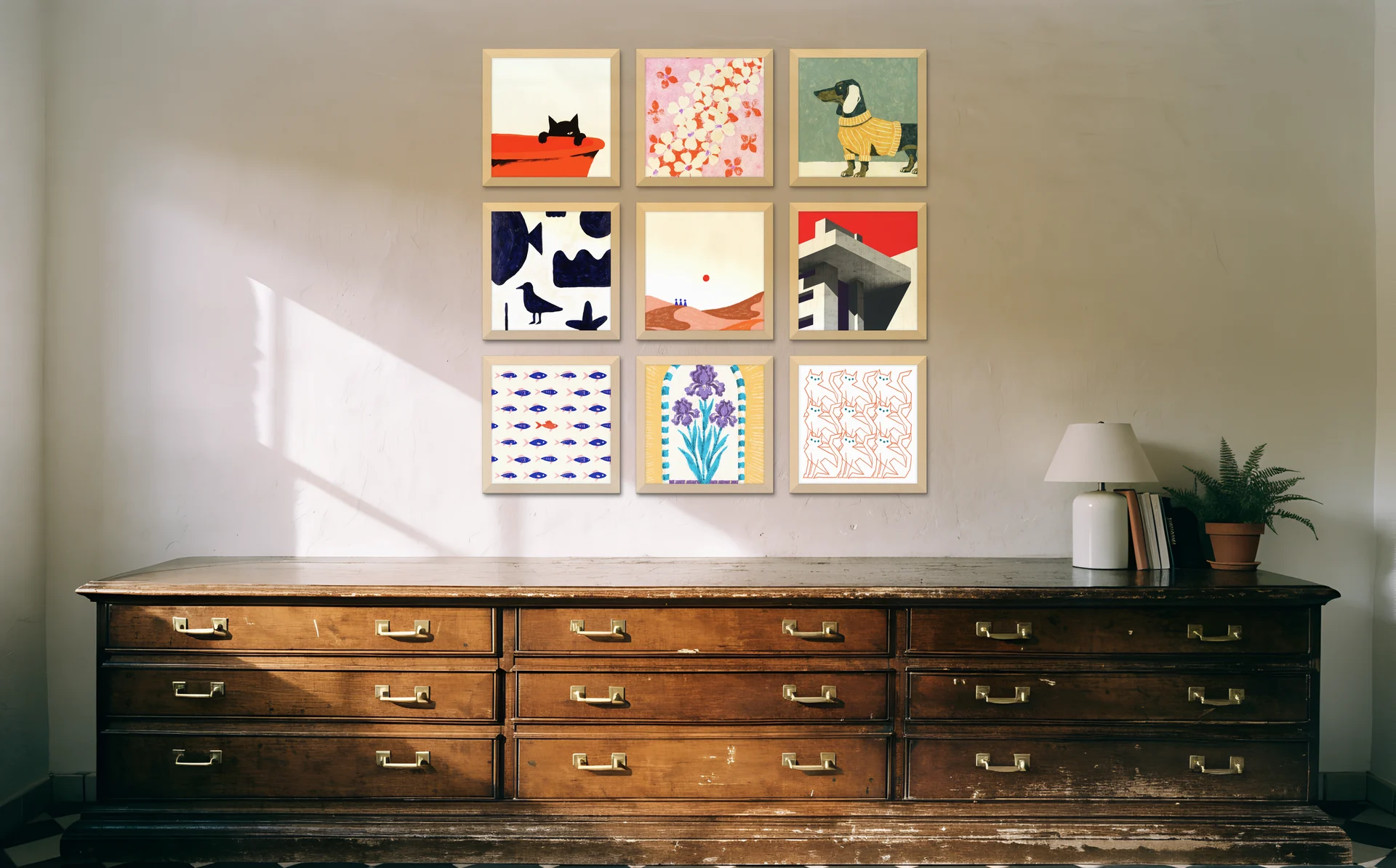
A grid gallery wall uses identical frames at one identical size, hung in even rows and columns with a single repeated gap between every piece. It is the calmest, most modern layout, and the easiest to plan, because every measurement repeats. Pick one frame size, buy multiples, set one gap (a tight 2 inch / 5 cm gap is standard), and you can calculate the whole block before you touch the wall.
This page goes deep on the grid alone. If you are still weighing a grid against a salon, symmetrical or row arrangement, start with the gallery wall layouts guide, then come back here to plan the grid in detail.
What is a grid gallery wall?
A grid gallery wall is a set of identical frames, all the same size and style, arranged in even rows and columns with the same gap between every neighbour. Nothing varies except the artwork inside. That single constraint, identical frames, is what gives the grid its clean, architectural calm and makes it the lowest-risk layout to get right.
The grid reads as deliberate rather than collected. Where a salon wall is judged by eye, a grid is measured: the uniformity does the composition work for you, so the arrangement is hard to get wrong once the frames match. That is why it suits modern and minimal rooms, and why it is the layout to choose when you want a precise, predictable result instead of an expressive one.
The trade-off is that a grid is unforgiving. The same order that makes it look sharp also makes any misalignment obvious, so one frame hung 3 to 4 mm (about an eighth of an inch) off shows at once. The fix is measurement, not skill, and the rest of this guide gives you the numbers.
What is the best content for a grid gallery wall?
A grid works best with a matching set: pieces that already belong together, so the eye reads the wall as one composition rather than a collection. The structure handles the order, and the shared content handles the cohesion. This is the layout for a series, not for a mix of things you have gathered over time.
Strong choices for a square gallery wall or grid include:
- A photo series in one treatment, for example nine black and white prints from one trip or one shoot.
- A set by a single artist, or a single print run sold as a collection.
- Botanical prints, vintage maps, or framed pressings, where the subject repeats.
- Typography or poster art in one type family and colour palette.
A grid also calms down bold colour. Because the frames and gaps are so regular, a set of vivid prints reads as intentional rather than busy, which is why colour-led sets pair so well with this layout. If your pieces are mixed in size, orientation or framing, a grid is the wrong choice; a salon arrangement absorbs that variety instead, and the gallery wall layouts pillar covers when to switch.
How many frames for a grid gallery wall?
Use a count that fills complete rows and columns so the grid stays a clean rectangle: 4, 6, 9 or 12 frames are the standard configurations. The number you pick is set by how many columns and rows fit your wall and furniture, and every frame is the same size, so the count and the size together fix the total footprint.
| Grid | Frames | Rows x columns | Typical use |
|---|---|---|---|
| 2x2 | 4 | 2 rows, 2 columns | Small square gallery wall, above a desk, in a narrow alcove or beside a door |
| 2x3 | 6 | 2 rows, 3 columns | A 6 frame grid gallery wall above a sofa, bed or sideboard, the most common size |
| 3x3 | 9 | 3 rows, 3 columns | A 9 frame grid as a balanced square statement on a larger wall |
| 3x4 | 12 | 3 rows, 4 columns | A full feature wall, a long landing, or a dining room |
A 2x3 (six frame) grid is the workhorse above sofas and beds, as long as the frames are big enough for the block to fill most of the furniture's width. A 3x3 (nine frame) grid gives you the most balanced shape, three even rows by three even columns, and sits centred on a plain wall. For how the count should relate to the furniture below, the gallery wall sizes guide is the canonical reference; the short version from MontCarta is that the arrangement should span 66% to 75% of the furniture width.
What size frames and what gap for a grid?
Every frame is the same size: that is the defining rule, so pick one size and buy multiples. The gap is also a single repeated figure. A tight 2 inch (5 cm) gap is the standard for a grid, and 1.5 inches (4 cm) gives a denser, more museum-like block. Whatever you choose, keep it dead even between every frame, because a grid relies entirely on that regularity.
Common single-frame sizes that suit a grid are 8x10 inch (20x25 cm), 11x14 inch (28x36 cm) and 12x16 inch (30x40 cm). Larger frames want the wider end of the standard gap so they do not feel cramped; smaller frames can take the tighter end. The full logic for choosing a gap, including how it changes with frame size, lives in the gallery wall spacing guide, which is the canonical post for the gap. Do not overthink it here: for a grid, one even gap in the 1.5 to 2 inch (4 to 5 cm) range, kept even between every frame, is the whole job.
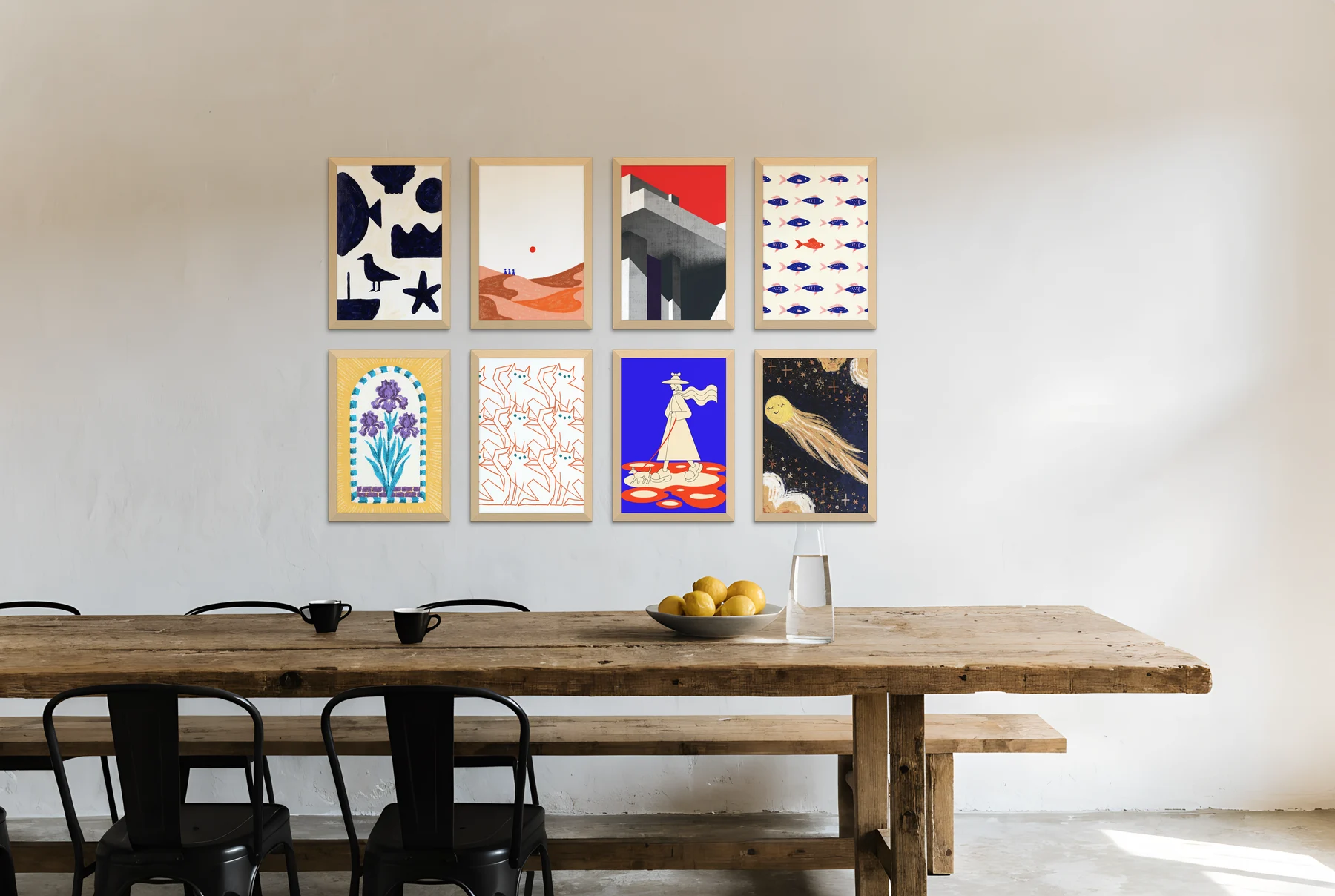
How do you calculate a grid gallery wall layout?
Because every frame and every gap is identical, the total footprint is a single sum you can do before buying anything. Use these two formulas, then mark the block on the wall to match.
- Total width = (columns x frame width) + ((columns minus 1) x gap)
- Total height = (rows x frame height) + ((rows minus 1) x gap)
That is the grid's real advantage over every other layout: you place a known rectangle rather than judging the balance by eye. The footprint is a sum, so you know it before you buy a single frame.
Worked example: a 3x3 grid of 11x14 inch frames
Take nine 11x14 inch (28x36 cm) frames in portrait orientation, in a 3x3 grid, with a 2 inch (5 cm) gap. Run the formulas:
- Width = (3 x 11) + (2 x 2) = 33 + 4 = 37 inches (94 cm)
- Height = (3 x 14) + (2 x 2) = 42 + 4 = 46 inches (117 cm)
So the whole block is about 37 inches (94 cm) wide and 46 inches (117 cm) tall. Turn the frames landscape and the two figures swap. Now you know the rectangle to centre on the wall, before a single hole.
For placement: on an empty wall, centre the block so its middle sits at 57 inches (145 cm) from the floor, the usual eye-level centre line. Above a sofa, measure from the furniture instead: put the bottom row 6 to 8 inches (15 to 20 cm) above the sofa back, or above the cushions if they sit higher, so the grid reads as connected to the seating. Within that range, pick the gap that brings the grid's centre closest to 57 inches (145 cm). The full height logic, including the 57-inch rule and when to override it, is covered in how high to hang a gallery wall.
How do you hang a grid gallery wall straight?
Measure precisely and check every frame with a spirit level, because a grid punishes any drift the moment it is up. The order that makes the layout look sharp is the same order that exposes a frame hung 3 to 4 mm (about an eighth of an inch) off. Three habits get it right on the first try.
First, work from a plan, not by instinct. Either cut a paper template per frame and tape the whole grid to the wall first, or lay it out in a planner so the rectangle and gaps are set before you drill. The paper-template and floor-layout method is set out in full in how to plan a gallery wall.
Second, use a fixed spacer. Cut one piece of card to your gap (50 mm for a 2 inch / 5 cm grid) and reuse it between every pair of frames, rather than re-measuring each gap. The card keeps the gaps identical, which is the one thing the eye checks on a grid.
Third, level every row. Mark your hook positions, hang the frames, then run a spirit level along the top edge of each row and adjust before you call it done. Before you drill or nail, check each mark with a cable and pipe detector, especially in line with sockets and switches. If you would rather make few or no holes while you test the arrangement, the sibling guide on a gallery wall without nails covers adhesive strips and ledges.
This is the step where a planner earns its place. With Curate, you upload a photo of your own wall, drop in a grid preset, and the planner snaps the frames into an even grid and keeps the gaps identical, so the layout is aligned on screen before you drill. It is free to plan, and you can preview the result on your phone.

Grid versus the other layouts, in one line
Choose a grid when your frames and prints already match, you want a calm, modern result, and you would rather measure than judge by eye. Choose a salon wall instead when your sizes are mixed and you want something expressive, or a symmetrical pair or row when you want formal order with fewer frames. The layouts pillar compares all of them side by side; the siblings on the salon, asymmetric and stairway layouts each go deep on one.
Frequently asked questions
How many frames are best for a grid gallery wall?
Use a count that fills complete rows and columns: 4 (2x2), 6 (2x3), 9 (3x3) or 12 (3x4). A 6 frame grid suits most sofas and beds if the frames are big enough to span 66% to 75% of the furniture's width, and a 9 frame grid makes a clean, balanced block on a larger plain wall.
What gap should I leave between frames in a grid?
One even gap, kept even between every frame. A 2 inch (5 cm) gap is standard, and 1.5 inches (4 cm) gives a denser, museum-style block. The exact figure matters less than keeping it identical; see the gallery wall spacing guide for the full logic.
How do I calculate the total size of a grid gallery wall?
Total width = (columns x frame width) + ((columns minus 1) x gap), and total height uses rows the same way. Nine 11x14 inch (28x36 cm) frames in a 3x3 grid with a 2 inch (5 cm) gap span 37 inches (94 cm) wide by 46 inches (117 cm) tall.
How high should a grid gallery wall be hung?
Centre the whole block at 57 inches (145 cm) from the floor on an empty wall. Above a sofa, instead put the bottom row 6 to 8 inches (15 to 20 cm) above the sofa back. See how high to hang a gallery wall for the full rule.
Why does my grid gallery wall look crooked?
A grid shows the smallest misalignment because everything else is so regular. Almost always the cause is an uneven gap or a frame slightly off level. Use a single cut-card spacer for every gap and run a spirit level along each row.
Work out your grid's rectangle with the formula above, then try it on a photo of your own wall with Curate before you mark a single hole. Drop in a grid preset, let the planner snap the frames even, and you can check the block fits and sits straight before the first nail goes in.