How to hang a salon style gallery wall that looks collected
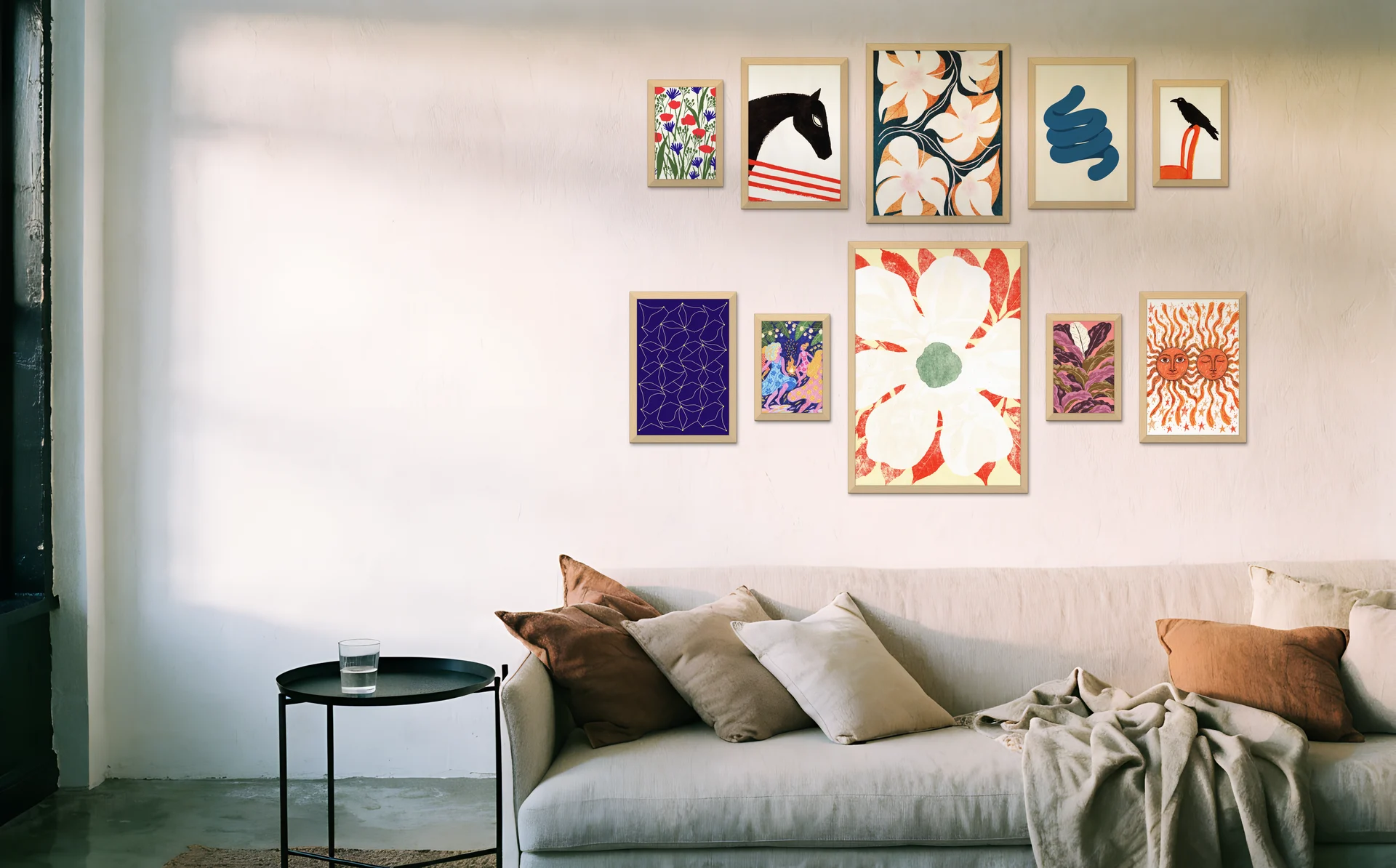
A salon style gallery wall is a dense, layered arrangement of mixed frame sizes and orientations, balanced by eye around a single anchor piece rather than lined up on a grid. You get the look right by placing your largest piece first, working outward, balancing visual weight side to side, and keeping a tight, even gap throughout. Done well it reads collected and personal. Done carelessly it reads cluttered.
The salon hang takes its name from the 18th and 19th century Paris Salon, where paintings were stacked frame to frame from the dado rail to the ceiling. That floor-to-ceiling density is still the defining trait: more art, more variety, less empty wall. The trick is that "freeform" does not mean "no rules". A salon wall that works is held together by a handful of quiet constraints. This guide gives you those constraints so you can balance a mixed wall instead of just stacking frames and hoping.
What is a salon style gallery wall?
A salon style gallery wall is an eclectic, layered display that deliberately mixes frame sizes, shapes and orientations, arranged around a centre line or a single anchor piece with tight, even gaps between frames. Unlike a grid, nothing repeats. The variety is the entire point, and the balance comes from how you distribute visual weight rather than from straight lines.
You will also see it called a salon hang, an organic gallery wall, or an eclectic gallery wall. The labels describe the same idea: a collected-over-time wall where a small abstract print might sit beside a large oil and a framed photo, all reading as one composition. It is the warm, lived-in cousin of the tidy grid layout, and the two sit at opposite ends of the same spectrum.
Salon hang versus a grid
The difference is order. A grid repeats one frame size and one gap across straight rows to feel calm and architectural. A salon wall throws out the matching frames and the straight rows on purpose, then earns its cohesion through balance and a repeated detail or two.
| Element | Salon style approach |
|---|---|
| Frames | Mixed styles and finishes, layered; cohesion comes from repeating one finish or colour, not from matching everything |
| Sizes | 2 to 4 different sizes plus one larger anchor, mixing portrait and landscape |
| Orientation | Both portrait and landscape, intentionally varied across the wall |
| Frame count | 6 to 15 or more; the format scales up well |
| Anchor | One larger or visually heavier piece, placed near the centre or slightly off it |
| Spacing | A consistent, tight gap, measured frame edge to frame edge |
| Outer shape | The whole group sits inside one imaginary rectangle or oval |
If you want the orderly opposite, see how a grid layout handles the same wall, or where an asymmetric layout sits between the two.
What is a salon hang best for?
A salon hang suits maximalist and collected interiors, and any wall you want to feel layered and lived-in rather than orderly. It is the natural home for a mix of art, prints and personal photos in varied frame styles, because the format absorbs that variety instead of fighting it. A collection that refuses to match is exactly its job.
It also works on a large blank wall. Because it scales up well, a salon arrangement of 12 or 15 pieces can fill a tall stairwell or a double-height living room wall where a neat row of three would look lost. If you want orderly and calm instead, the grid layout is the better choice, and a stairway arrangement follows a staircase more naturally than a freeform cluster. For help choosing across every style, start at the gallery wall layouts guide.
How many frames and what sizes for a salon wall?
Plan on 6 to 15 frames or more, in 2 to 4 different sizes plus one larger anchor piece, mixing portrait and landscape. The size variety is what separates a salon wall from a grid, so resist the urge to make everything similar. A wall of near-identical frames reads as a failed grid, not a deliberate salon hang.
Think in tiers rather than exact dimensions. You want one clear anchor, a few medium pieces, and a scattering of small ones to fill the gaps and soften the edges. Mixing orientations matters as much as mixing sizes: a tall portrait frame next to a wide landscape one creates the rhythm that makes the arrangement feel alive. For exact frame dimensions, how big the anchor should be, and how to size the group to your furniture, the gallery wall sizes guide is the canonical source. Its rule of thumb is to span 66 to 75% of the width of the furniture below, attributed to MontCarta.
How much spacing between frames on a salon wall?
Keep a tight, visually even gap of about 2 inches (5 cm), measured frame edge to frame edge rather than centre to centre. Because salon frames vary in size, centre-to-centre spacing would push the edges to uneven distances and break the cohesion. That even edge-to-edge gap is one of the things holding a busy salon wall together.
Even spacing does more work than people expect. When every gap matches, the eye reads the cluster as one object even though the frames inside it are all different. The moment the gaps drift to 1 inch (2.5 cm) here and 4 inches (10 cm) there, the wall starts to look accidental. A tighter gap suits a dense salon hang because it reinforces the collected, layered feel; wider gaps make the group feel scattered. Spacing is its own subject with its own trade-offs, so for the full reasoning and the usual range see the gallery wall spacing guide, which lands on 2 to 3 inches (5 to 7.5 cm).

How to plan a salon style gallery wall
Place the anchor first, build outward, and balance visual weight from side to side while holding the gap constant. The hard part of a salon wall is that there is no grid to fall back on, so you are composing by eye. A clear order of operations turns that from guesswork into a method.
Place the anchor first
Start with your largest or visually heaviest piece and set it near the centre of the arrangement, or slightly off centre. This is your gravitational point. Everything else hangs in relation to it, so once it is placed the rest of the wall has a reference and the decisions get easier.
Work outward and balance the weight
Add medium and small frames outward from the anchor, watching the balance left to right and top to bottom. Visual weight is not just size: a large dark print or a heavy frame pulls the eye as much as a big one does. Balance a single heavy piece on one side with a cluster of smaller, lighter frames on the other, so neither half of the wall feels like it is tipping. You are aiming for equilibrium, not symmetry.
Hold the gap and the outer boundary
Keep that 2 inch (5 cm) edge-to-edge gap consistent as you go, and imagine the whole group fitting inside one rectangle (or a soft oval). Letting the outer frames align loosely to that shared boundary is what stops a layered wall from spilling messily across the room. The internal arrangement can be loose, even while the outer silhouette stays controlled.
Why does my salon wall look cluttered, and how do I fix it?
A salon wall looks cluttered when the gaps are uneven, the outer edges sprawl with no shared boundary, and nothing repeats to tie the pieces together. The fix is three things at once: make every gap match, contain the group inside one imaginary outer shape, and repeat one element, usually a frame finish or a colour, across the wall.
That repeated thread is what most people miss. Mixed art on its own can look like clutter, but the moment three black frames or a recurring shade of ochre echo across the arrangement, the eye finds a pattern and the whole thing settles. Pick one constant and let everything else vary.
The other classic salon mistake is hanging straight from the box. Eyeballing a dozen mixed frames on the wall, hole by hole, almost never balances, and every misjudged nail is another patched hole. Plan the arrangement flat first. Lay the frames out on the floor and shuffle them until the balance reads, or cut paper templates and tape them to the wall to test the composition before you commit; the full floor and paper-template method lives in the how to plan a gallery wall guide. If you would rather skip the nails entirely, the no-nails gallery wall guide covers strip and rail options.
To judge your own wall honestly, borrow the test stylist Emily Henderson uses: "Pretend it's not your house and that you have no emotional connection to it." Looking at the arrangement as a stranger would makes the lopsided corner or the one frame that does not belong jump out, where affection for a favourite piece would otherwise hide it.
This is also where planning on a photo of your actual wall pays off. The Curate planner lets you drop mixed frames onto a picture of your room, shuffle them freely, and keeps the gaps even while you balance the composition, so you can try a dozen arrangements without committing to one. It is free to use for planning.
A quick word on height while you compose: treat the cluster as one unit and centre that unit at roughly eye level, the standard 57-inch (145 cm) centre line. The how high to hang a gallery wall guide is the canonical source for height, including how to follow a staircase slope.
Frequently asked questions
What is the difference between a salon hang and an eclectic gallery wall?
There is no real difference. "Salon hang", "eclectic gallery wall" and "organic gallery wall" all name the same dense, mixed arrangement balanced by eye around an anchor rather than a grid. Treat the terms as interchangeable.
How many pieces do I need for a salon style gallery wall?
Six to 15 or more, in 2 to 4 sizes plus one larger anchor. The format scales up well, so a tall or wide wall can carry 15 pieces comfortably while a smaller wall reads fine with 6 to 8.
How do I stop a salon wall looking messy?
Match every gap (a tight 2 inch or 5 cm gap works well), keep the whole group inside one imaginary outer rectangle, and repeat a single element such as a frame finish or a colour. Those three constraints are what turn a pile of frames into one composition.
Should I measure spacing centre to centre or edge to edge on a salon wall?
Edge to edge. Salon frames are different sizes, so centre-to-centre spacing would leave the visible gaps uneven. Measuring frame edge to frame edge keeps the spacing looking consistent. The gallery wall spacing guide has the detail.
Where should the anchor piece go?
Near the centre of the arrangement, or slightly off it, using your largest or visually heaviest piece. Build the rest of the wall outward from there, since the anchor gives every other frame its reference point.
Try one on your own wall before you drill. Upload a photo of your room into the Curate planner, drop in a mix of frames and prints, and shuffle them until the balance reads right.